

 Feed back
 Privacy Policy
The Federal motor carrier safety regulations established by the FMCSA carry real weight in the commercial trucking industry. For professional drivers operating under 49 C.F.R. § 383.51, understanding the CDL violation consequences for truck drivers isn't just about avoiding tickets—it's about protecting livelihoods. With over 3.5 million CDL holders in the U.S. according to the Bureau of Labor Statistics, compliance with Commercial vehicle compliance standards has never been more critical.

A 2022 FMCSA case study reveals how a Texas-based trucker lost his CDL violation consequences for truck drivers privileges permanently after three violations under 49 C.F.R. § 383.51. The driver, who had previously received warnings for hours-of-service violations, faced disqualification after a reckless driving incident involving a 12% speed violation in a work zone. This case demonstrates how the FMCSA's three-strike policy under Federal motor carrier safety regulations can terminate careers.
The FMCSA's 2023 Annual Report documents sobering statistics about Commercial vehicle compliance failures:
These figures from the USDOT highlight the strict enforcement of Federal motor carrier safety standards across state lines.
The FMCSA's Safety Measurement System (SMS) tracks seven Behavior Analysis and Safety Improvement Categories (BASICs) that directly correlate with CDL violation consequences for truck drivers. Their 2023implementation of real-time electronic logging device (ELD) monitoring has increased Commercial vehicle compliance verification by 37% according to industry reports.
Under 49 C.F.R. § 383.51, the FMCSA employs a tiered penalty system for Federal motor carrier safety violations:
The American Transportation Research Institute confirms these escalating CDL violation consequences for truck drivers reduce repeat offenses by 63%.
A 2023 Trucking Industry Recruitment Survey shows 89% of carriers automatically reject applicants with CDL violation consequences for truck drivers on their Pre-Employment Screening Program (PSP) reports. Major violations under 49 C.F.R. § 383.51 can limit employment options to only 11% of available positions, often with 15-20% lower pay according to compensation data.
The Trucking Insurance Rating Bureau reports that Commercial vehicle compliance violations increase insurance premiums by an average of $4,800 annually per vehicle. For owner-operators, a single Federal motor carrier safety violation can raise operating costs by 18-22% when factoring in higher insurance deductibles and compliance monitoring fees.
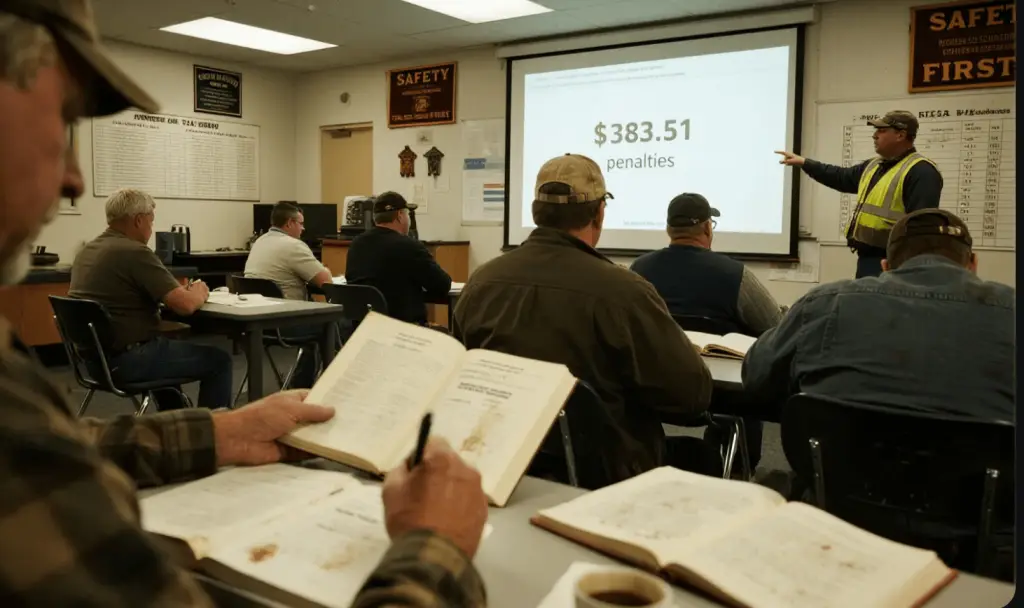
The CDL violation consequences for truck drivers under 49 C.F.R. § 383.51 create lasting professional and financial challenges. With the FMCSA's Federal motor carrier safety enforcement becoming increasingly data-driven, maintaining Commercial vehicle compliance isn't just about avoiding penalties—it's about sustaining a viable career in an industry moving toward zero-tolerance safety cultures.
How does 49C.F.R. § 383.51 treat out-of-state violations?
The FMCSA's reciprocity agreements mean all violations apply to your CDL regardless of where they occur. A 2022 FMCSA memorandum clarified that interstate enforcement of CDL violation consequences for truck drivers is mandatory under federal law.
Can you negotiate CDL violation penalties?
While you can request administrative hearings, the Federal motor carrier safety regulations under 49 C.F.R. § 383.51 allow minimal discretion. The Commercial Vehicle Safety Alliance reports only 12% of contested violations result in reduced penalties.
Do all violations affect CSA scores equally?
No. The FMCSA's Compliance, Safety Accountability program weights violations differently. Critical Commercial vehicle compliance failures like logbook violations carry 7-10 times more impact than minor equipment violations.
DISCLAIMER: The information provided regarding CDL Violation Consequences is for general informational purposes only and does not constitute legal or professional advice. Regulations change frequently, and specific circumstances may alter outcomes. Always consult with qualified legal counsel or FMCSA representatives for guidance on your particular situation. The author and publisher disclaim any liability for actions taken based on this content.
Michael Carter
|
2025.08.06
